How to read a birth chart: a step by step beginner's guide
Opening your birth chart for the first time? Here is the exact reading order: the Sun-Moon-Rising trio, houses, aspects and chart rulers.
AstroKolly's content team; all calculations come from the site's own ephemeris and chart engine.
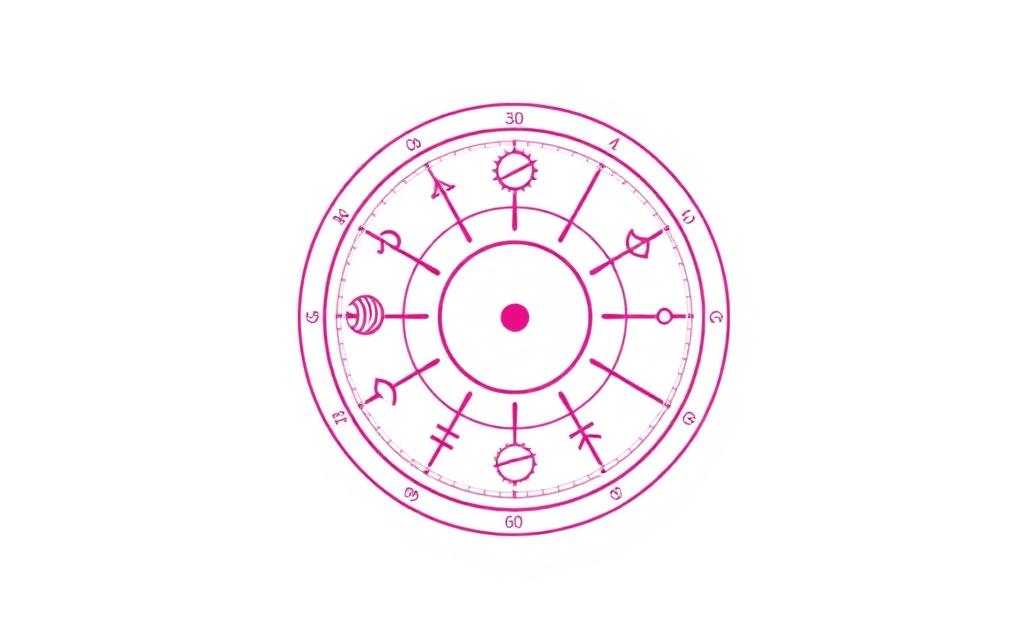
A birth chart is a frozen photograph of the sky as it looked from your birthplace at the moment you were born. It holds twelve signs, twelve houses, the planets and the aspects between them. Feeling lost the first time you open it is normal, because four layers are speaking at once. This guide unpacks those layers in order, so you can read your own chart in a sequence that actually makes sense.
What you need first
An accurate chart needs three things: date of birth, time of birth and place of birth. Time matters most, because the rising sign changes roughly every two hours and the whole house system shifts with it. If you don't know your time, the chart can still be cast, but read house placements carefully and focus on planets by sign and on aspects.
- Date of birth: day, month, year.
- Time of birth: to the minute if your records allow.
- Place of birth: the city is enough, coordinates and time zone are handled for you.
- Daylight saving: the site's ephemeris engine corrects this automatically by date.
You can cast your own chart in the Charts section; the wheel, planetary degrees and the aspect list come out together.
Step 1: the Sun, Moon and Rising trio
Always start here. The Sun describes what you are growing toward and the motivation at the centre of your life. The Moon describes your inner world, your emotional needs, what makes you feel safe. The Rising is the door to the outside world: your first impression, your reflex, your way of entering a situation. When the three agree, a person feels whole; when they conflict, you get the familiar feeling of housing two people at once.
The Sun is what you grow toward, the Moon is what you need, the Rising is the face seen when you open the door.
Step 2: houses, or which area of life
Signs answer how, houses answer where. A planet's sign gives the style, its house gives the arena. A Leo Venus wants a stage; in the 2nd house it shows up around money and worth, in the 7th in partnership, in the 10th in career.
- 1st: body, appearance, how you enter life.
- 2nd: money, self-worth, resources, talents.
- 3rd: communication, siblings, local life, short trips.
- 4th: family, roots, home, emotional foundation.
- 5th: creativity, dating, children, play and pleasure.
- 6th: routine, work systems, health, service.
- 7th: relationships, marriage, partnership, open rivals.
- 8th: shared resources, crisis, transformation, intimacy.
- 9th: higher study, belief, travel abroad, the wider view.
- 10th: career, status, public role.
- 11th: friends, community, long-term goals.
- 12th: the unconscious, retreat, closed doors, healing.
An empty house is not a missing life area. It simply means the topic is run by its ruler from somewhere else. Plenty of people with an empty 7th house marry.
Step 3: follow the house rulers
This is the heart of a professional reading. Each house cusp has a sign, that sign has a ruler, and wherever that ruler sits is where the topic is actually handled. If Libra sits on your 10th, Venus rules your career; if Venus is in the 6th, your career runs through daily work, service and health.
Step 4: aspects and orbs
An aspect is the degree relationship between two planets, and it is where the chart's conversation happens. Conjunctions merge, trines flow, sextiles offer, squares press and oppositions seek balance. Squares and oppositions are not bad; they are where energy works through friction, and usually where your strongest muscles are. Orb matters: 0-3 degrees is very strong, 3-6 clear, 6-8 mild.
- Conjunction (0°): two energies become one body.
- Sextile (60°): easy, but it needs a deliberate step.
- Square (90°): pressure, repeated friction, greatest growth.
- Trine (120°): natural talent, effortless flow, can breed laziness.
- Opposition (180°): swinging between two poles, mirrored in relationships.
Step 5: element and modality balance
Look at how the planets spread across the elements. Fire-heavy means drive and inspiration with little patience. Earth-heavy means substance with less flexibility. Air-heavy means plenty of ideas but difficulty naming feelings. Water-heavy means deep intuition and porous boundaries. A missing element is information too: with no earth, life keeps handing you budgets, plans and routines as homework.
Step 6: standout patterns
Finally, look for what stands out: three or more planets in one sign or house is a stellium and that topic dominates. A planet tight to the Ascendant or Midheaven becomes a signature. Retrograde planets turn energy inward, and 0 or 29 degrees say a topic is either brand new or nearly finished.
The reading order in short
- Write down the Sun, Moon and Rising.
- Note every planet's sign and house.
- Find the ruler of the Rising and where it sits.
- Mark the three tightest aspects.
- Work out element and modality balance.
- Flag stelliums, retrogrades and 0/29 degrees.
- Combine everything into one paragraph in your own words.
If you'd rather not do it by hand, the natal chart reading in the profile section follows exactly this order, and the yearly analysis report combines the same chart with current transits.
Common mistakes
- Reading only the Sun sign and closing the chart.
- Treating squares and oppositions as catastrophes.
- Skipping house rulers and reading a flat list of planets.
- Trusting house interpretations when the birth time is uncertain.
- Generalising from a single placement; a real theme repeats at least twice in a chart.